Find Your “Why”
Most businesses can tell you why they do what they do in a single sentence.
“I’m a therapist.”
“I’m a photographer.”
“I sell skincare.”
“I run a café.”
Clear. Practical. Also… interchangeable.
If your marketing feels like it’s blending into the beige wallpaper of the internet, it’s usually because you’re leading with “what,” hoping people will magically feel the difference. Sometimes they do. Mostly… they don’t.
This is where your “why” comes in. Not as a poetic garnish, but as a working tool. A clear why gives your business a spine. It helps people understand what you stand for, it makes your offers easier to choose, and it stops your brand from shape-shifting every time you see a competitor post something shiny.
Simon Sinek’s Golden Circle is one of the most widely shared frameworks for this idea. It’s simple, and it sticks because it names a real pattern: inspiring businesses tend to communicate from the inside out – starting with why, then how, then what.
What the Golden Circle is (and Why it Works)
Sinek’s Golden Circle has three layers:
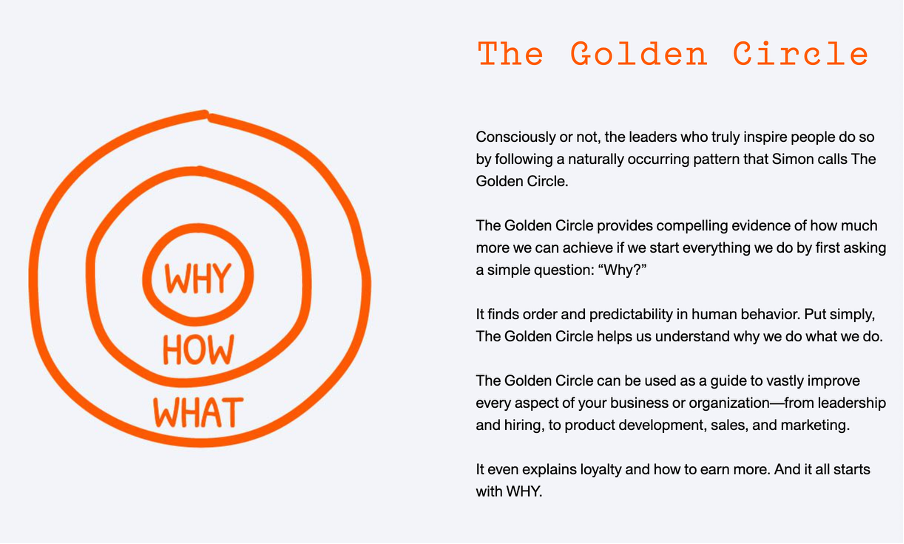
Why: purpose, cause, belief: why you exist beyond money.
How: the principles, methods, or values that make you different.
What: the products or services you sell.
The classic line from Sinek’s talk is that people don’t buy what you do; they buy why you do it.
Whether you take that as literal truth or helpful shorthand, the practical takeaway is solid. When people understand what drives you, they can decide faster if you’re “their kind of business.”
Because buyer aren’t only comparing features. They’re comparing meaning, fit, and trust.
A strong why also matters internally. Purpose and clarity help teams make consistent decisions and build trust over time (and yes, it applies to solo businesses too as you are the team!)
What a “Why” is Not
Before you write one, here’s what commonly goes wrong:
“My why is to make money”
Money is a result. It’s not a reason someone chooses you over the next option.“My why is to help people”
Noble, but vague. Help who, with what, in what way, and what do you believe about how that help should feel?“My why is my product”
That’s a what. If your why changes when your offer changes, it’s not a why. It’s packaging.“My why is a motivational quote”
If it can be printed on a mug at Kmart and still make sense, it’s probably not specific enough.
A useful why is stable. It can outlast a pivot. It can guide a decision. It can be proven by behaviour.
How to Find Your “Why”
Here are three practical ways to pull your “why” out of your head and onto the page.
Method 1: The “So That” Ladder
Start with what you do, then keep asking “so that…” until you hit belief.
Example (a physio clinic):
We help people rehab injuries… so that they can move without pain… so that they can trust their bodies again… so that life feels possible, not limited.
That last part is the “why” territory.
Method 2: The Pattern Audit
Look back at your favourite clients/projects/customers and ask:
What did they come to you believing?
What changed after working with you?
What do you refuse to do, even if it would sell?
What do you always prioritise?
Your why often shows up in what you protect.
Method 3: The Origin Moment (not the highlight reel)
This is less “tell me your inspiring founder story” and more: what problem made you quietly furious?
For me, my work is grounded in the moment I realised so many digital spaces weren’t designed for real humans especially if your brain, body, identity, or energy levels don’t match the “default user.” That lens (as a queer, neurodivergent, disabled designer) shapes everything I build: clarity, accessibility, emotional safety, no jump-scare websites. The “why” isn’t a slogan. It’s the reason I care about making brands that feel steady and usable.
Turn Your Why into Words
A good “why” statement should be short enough to remember, specific enough to guide, and true enough to live.
Try one of these, if you’re stuck:
Belief & Change
“We believe [belief], so we help [who] [do/feel/achieve] [change].”Against/For
“We’re here to push back on [common industry problem] by doing [your approach] so that [outcome].”The Promise
“We exist to make [specific thing] feel [specific feeling] for [specific people].”
Example (a café)
“We exist to make mornings feel less rushed and more human, especially for locals who want a place that remembers them.”
Example (a bookkeeper)
“We exist to make money feel clear and manageable for small business owners who are tired of feeling behind.”
Notice how none of these mention products yet? That comes next.
Your “why” should show up in five places:
Your bio/homepage intro
Your “About” page
Your content themes
Your offers and boundaries
Your CTAs
A quick example using the Golden Circle (so it’s not just another theory I’ve thrown your way).
Let’s say you’re a counsellor.
Why: You believe people deserve support that feels respectful, not clinical or shaming.
How: You practice trauma-informed care, create clear expectations, and offer flexible ways to begin (email, booking link, short consult)
What: You provide 1:1 counselling sessions, workshops, and resources
Now your caption isn’t just “appointments available.” It becomes:
“If you’ve been putting off getting support because you don’t want to be judged, here’s what working together looks like…”
That’s why —> how —> what, in plain language
Every business needs a why because it makes your brand clearer, your decisions easier, and your marketing more distinctive. Simon Sinek’s Golden Circle is a practical model for communicating inside-out. Starting with “why” (purpose/belief), then how (your approach), then what (your offer). When your “why” is specific and grounded, it becomes a filter for what you create, what you say, and who you serve.
If your business is growing but your messaging still feels “off” or “boring” or “same same,” it’s probably not because you’re doing nothing special. It’s most likely because your “why” hasn’t been translated into language people can repeat.
If you want help defining your “why” and turning it into clear positioning, content direction, and a brand that feel unmistakably yours, book a discovery call with me.
You can also explore my services if you’re ready for a full strategy and identity build or check out my store for more.